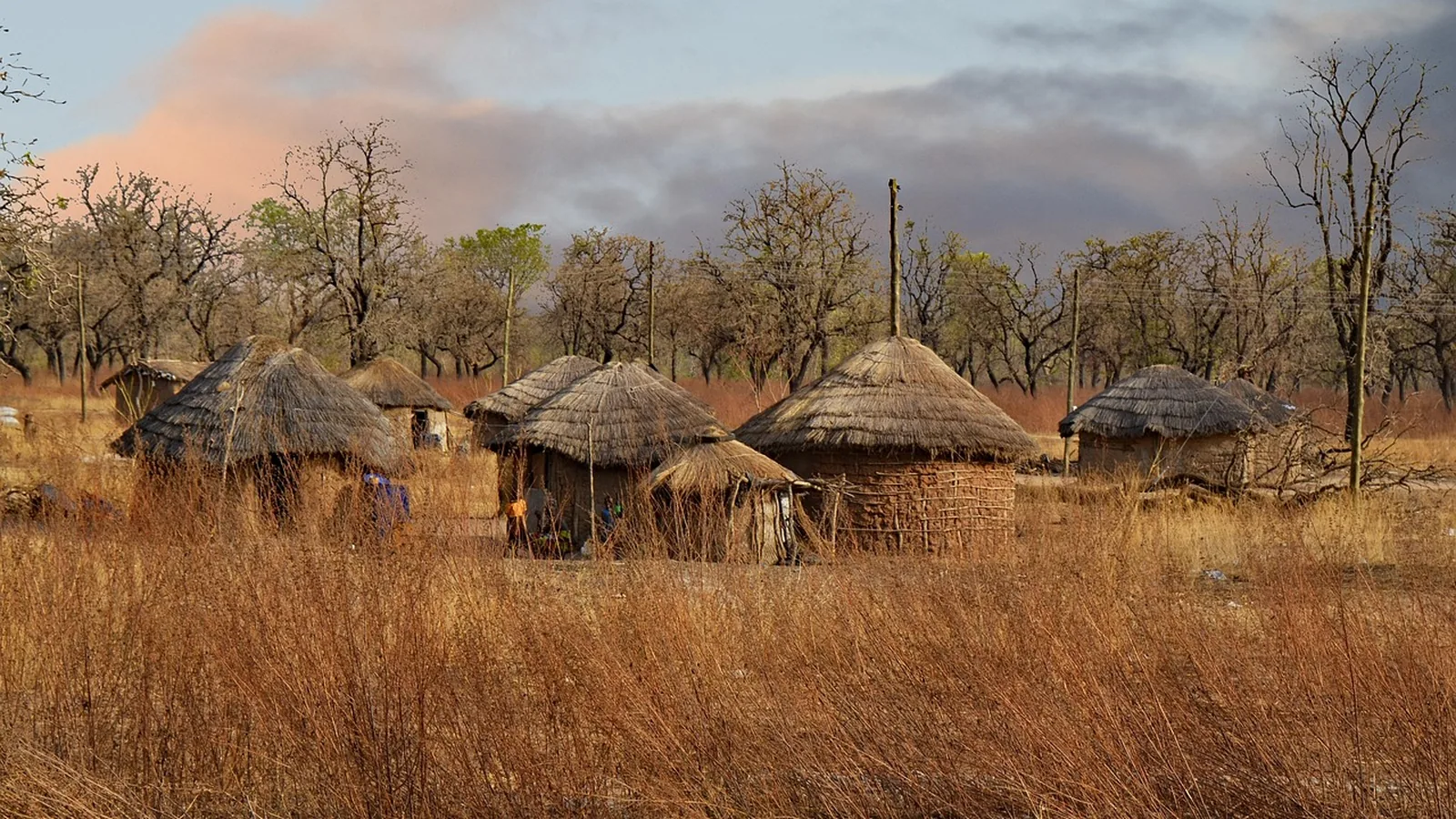
Photo: lapping, Pixabay
7 June 2026
9 min
· Rédaction Imonga
Tamale is the Northern regional capital and the largest metropolis in that part of Ghana. According to the Tamale Metropolitan Assembly composite budget, accessed on 30 September 2026 at mofep.gov.gh, the metropolis had a population of 374,744 at the 2021 census, of which 80.8% lived in urban areas. Buying or renting in Tamale requires understanding this demographic pressure, checking land title, and budgeting for registration fees, just as in other major Ghanaian cities such as Accra or Kumasi.
A market under demographic pressure
Tamale's growth rests on high fertility, positive net migration, and falling mortality, as noted in a 2022 Ghana Journal of Development Studies paper accessed on 30 September 2026 at ajol.info. The housing deficit is acute: the same paper states that in 2000 the metropolis already lacked 18,690 units, according to Ghana Statistical Service data. Nationally, supply meets only about 33% of annual requirements.
The 2023 composite budget of the metropolitan assembly, accessed on 30 September 2026 at mofep.gov.gh, gives the current housing stock: 19,387 houses for 35,408 households, an average household size of 6.3 persons. Urbanisation is massive: roughly four in five residents live in town. This gap between households and housing stock explains why finding a property quickly is difficult and why self-contained dwellings are generally reserved for health workers, teachers, or NGO staff.
A social housing project shows the lower end of the market. Reall, accessed on 30 September 2026 at reall.net, financed the construction of 100 basic 65 m² homes in Tamale by Afreh Group, on a 12-hectare site 10 km from the city centre. Each unit has water, sanitation, and power. Loans run for 60 months at a 16% interest rate. Most buyers previously rented accommodation costing slightly more than the planned monthly repayment. Total project investment is GHS 16,356,783.
Land law: freehold banned for non-citizens
In Ghana, the 1992 Constitution of Ghana and the 2020 Land Act of Ghana strictly limit foreign buyers' rights. According to Herald Law, accessed on 30 September 2026 at heraldlawgh.com, Article 266(1) of the Constitution of Ghana limits any leasehold granted to a non-citizen to fifty years. Section 10 of the Land Act, 2020 (Act 1036) of Ghana states: "No freehold interest shall be granted in favour of a non-citizen." Any deed, contract, or conveyance attempting to create freehold for a non-citizen is therefore void.
The Land Act, 2020 (Act 1036) of Ghana, section 10, restates this ban: no freehold interest shall be granted in favour of a non-citizen. Article 266 of the 1992 Constitution of Ghana limits any leasehold in favour of a non-citizen to fifty years. The freehold reversionary interest falls to the State and is held by the President in trust for the people of Ghana. To secure your purchase, appoint a lawyer or notary independent of the seller.
Buyer closing costs
The buyer must budget beyond the property price. According to the Ghana Revenue Authority (GRA), accessed on 30 September 2026 at gra.gov.gh, stamp duty is governed by the Stamp Duty Act, 2005 (Act 689) of Ghana. It applies to instruments that transfer land interests and is calculated ad valorem at between 0.25% and 1% of the instrument's value, or as fixed amounts from GH₵0.05 to GH₵25.
According to The African Vestor, accessed on 30 September 2026 at theafricanvestor.com, total buyer closing costs in Ghana typically range from 6% to 8% of the purchase price for a standard transaction. This includes legal fees of roughly 3% to 5% of the property value, plus stamp duty. If the title is complex or negotiation requires extra due diligence, costs can rise to 10% to 15% of the price. The African Vestor breaks down stamp duty bands as follows:
| Value band (GH₵) | Stamp duty rate |
|---|---|
| Up to 10,000 | 0.25% |
| 10,000 to 50,000 | 0.50% |
| Above 50,000 | 1% |
Ghana does not offer a first-time buyer stamp duty exemption. To plan the full cost, the guide to property purchase fees in Ghana sets out the steps.
Renting in Tamale
The rental market faces the same pressure as the sales market. Formal housing supply remains low relative to the number of households. Many tenants turn to compound houses, where several families share kitchen and toilet facilities, or to rental units near the central trading areas. Before signing a lease, read the clauses on rent review, notice period, and refund of the security deposit. Ask for the last three electricity bills to estimate real running costs. Rules differ markedly elsewhere in West Africa; for Togo, see our land title guide.
Checks before signing
Have an independent search done at the Lands Commission to confirm that the seller is the registered owner and that the property is not already encumbered. Insist on a clear leasehold with an approved site plan. Do not pay any deposit before a sale agreement is drafted and reviewed by your own lawyer. Start by examining the original documents, then compare the registry information with the situation on the ground. If the site plan appears old or inaccurate, appoint a surveyor to confirm the actual boundaries. Also check that property tax payments are up to date with the local authorities. To secure a land purchase, follow the precautions in our article on land buying precautions, and stay alert for common scams in West Africa.
Frequently asked questions
Can a foreigner buy land in Tamale?
No freehold is possible. Under Section 10 of the Land Act, 2020 (Act 1036) of Ghana, accessed on 30 September 2026 at heraldlawgh.com, no freehold interest shall be granted in favour of a non-citizen. Article 266(1) of the 1992 Constitution of Ghana limits any leasehold in favour of a non-citizen to fifty years at a time. Have a lawyer or notary verify the title.
What should a buyer budget for closing costs?
According to The African Vestor, accessed on 30 September 2026 at theafricanvestor.com, total buyer closing costs in Ghana generally amount to 6% to 8% of the purchase price. Stamp duty, set by the GRA in bands from 0.25% to 1%, is added to legal fees. Allow 10% to 15% if the file is complex.
What is the population of Tamale?
The 2021 census puts the Tamale Metropolis population at 374,744, according to the assembly's 2023 composite budget, accessed on 30 September 2026 at mofep.gov.gh.
Is the Tamale rental market tight?
Yes. With 35,408 households for 19,387 recorded homes in 2021 and a documented historical deficit, demand outstrips supply. Most households rent, often in compound houses, according to the composite budget data accessed on 30 September 2026 at mofep.gov.gh.
Do I need a lawyer to buy in Tamale?
Yes. Verifying title at the Lands Commission, analysing the leasehold, and drafting the instruments all require legal counsel. Choose a lawyer or notary independent of the seller.
Are new homes available in Tamale?
Yes, but volume is limited. The Reall project of 100 units 10 km from the centre, accessed on 30 September 2026 at reall.net, shows that structured supply exists mainly through small social housing schemes or cooperative programmes.
Sources
- Tamale Metropolitan Assembly, Composite Budget 2023, Ministry of Finance (Ghana) : establishes Tamale's population (374,744 in 2021), housing stock (19,387 houses, 35,408 households), and average household size (6.3 persons). Accessed on 30 September 2026.
- Yahaya A.-K., "Population Growth in the Tamale Metropolis", Ghana Journal of Development Studies, 2022 : establishes the 2000 housing deficit (18,690 units) and demographic pressure. Accessed on 30 September 2026.
- Reall, "Tamale Project", Data Dashboard : establishes the 100-home project features (65 m², 16% interest rate, 60-month loans) and location 10 km from the centre. Accessed on 30 September 2026.
- Herald Law, "Land Acquisition under the Laws of Ghana" : establishes Article 266 of the 1992 Constitution on the 50-year leasehold cap for non-citizens and Section 10 of the Land Act 2020 (Act 1036) on the freehold ban for non-citizens. Accessed on 30 September 2026.
- Ghana Revenue Authority, "Stamp Duty" : establishes stamp duty rates (0.25% to 1% ad valorem) and the Stamp Duty Act, 2005 (Act 689). Accessed on 30 September 2026.
- The African Vestor, "The full list of property taxes, costs and fees in Ghana (2026)" : establishes total closing costs (6% to 8%), stamp duty bands (0.25% / 0.5% / 1%), and the absence of first-time buyer relief. Accessed on 30 September 2026.
Read next
Real estate in Tema (Ghana): buying or renting on TDC-managed land
In Tema, Ghana, the question that comes before all others is the lease: who granted the land, for how many years, and on what terms. The rules for buying, registering and renting, with their sources.
Real estate in Kumasi (Ghana): prices, neighbourhoods and land security
Kumasi, Ghana's second city, shows a median residential price of about GH₵ 1.2 million in 2026. This guide details neighbourhoods, buyer closing costs and land law rules that protect the purchaser.
Real estate in Cape Coast (Ghana): land law, renting and formalities
Cape Coast is a historic city in Ghana's Central Region. Its real estate market relies largely on private renting and leasehold. This guide outlines the legal framework and registration formalities.
Real estate in Takoradi (Ghana): buying and renting guide
Takoradi's property market draws strength from its port and oil services. This guide covers leasehold rules, lending rates and essential checks before buying or renting.
Explore real estate in Tamale
Ready to move from reading to searching? Browse verified listings or get a free valuation.
From reading to searching
The advice above is worth most when applied to a specific property. 122 listings are online, viewable without an account.