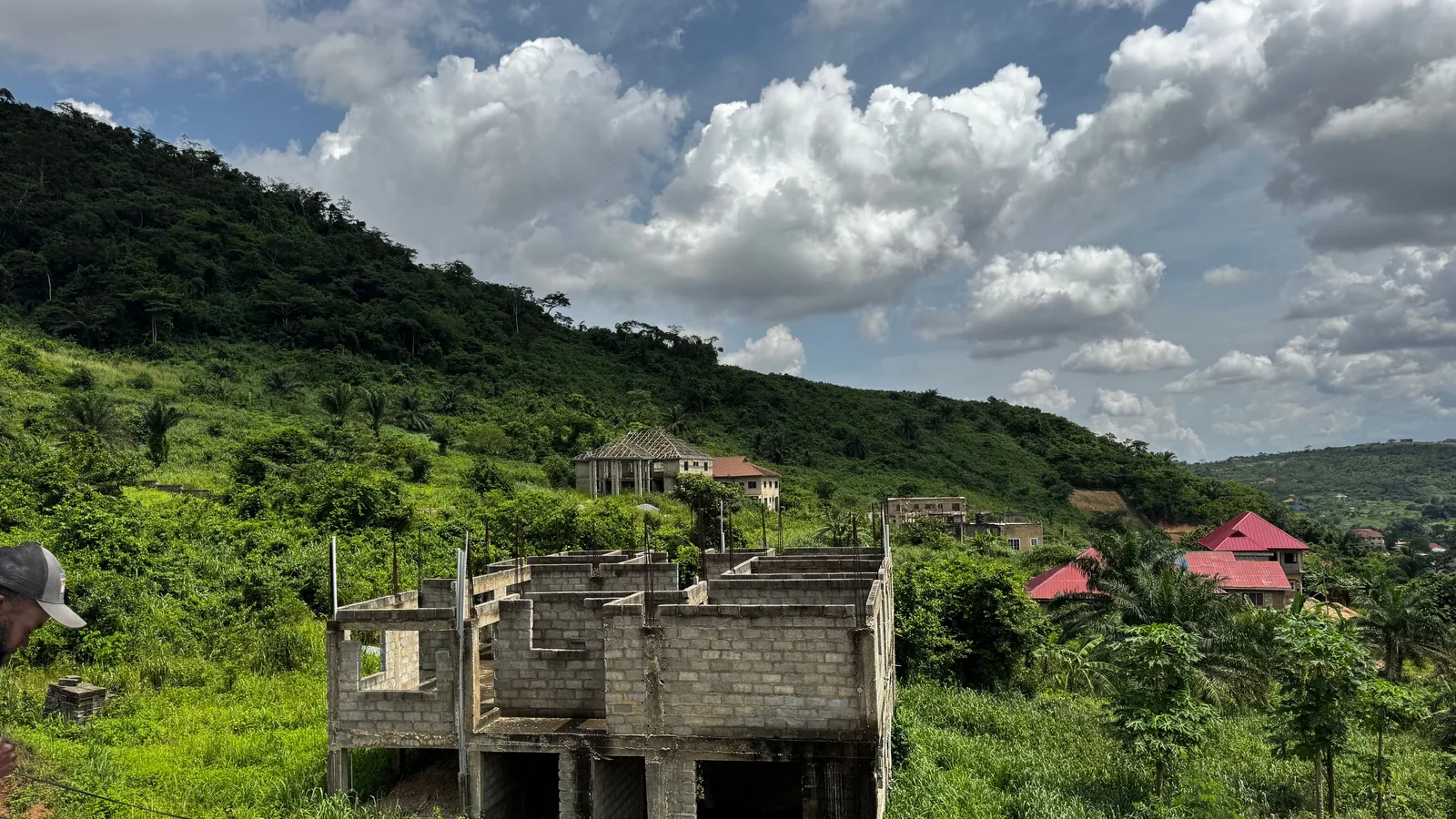
Photo: Prince Enos, Pexels
7 June 2026
10 min
· Rédaction Imonga
If you live abroad and are looking at houses for sale in Ghana, your citizenship decides what you can hold. The Constitution bars anyone who is not a citizen of Ghana from freehold ownership and caps their lease at fifty years. A Ghanaian who has taken a second nationality is still a citizen, so that cap is not aimed at them. Either way, the purchase is made safe by a Lands Commission search, a stamped and registered deed, and a Ghanaian lawyer who does not act for the seller. This article gives no price per square metre: we found no public, verifiable price series.
Citizen or not: what you can hold in Ghana
A non-citizen can only take a leasehold of fifty years at most. The rule is article 266 of the 1992 Constitution of Ghana (accessed 11 October 2026):
“No interest in or right over any land in Ghana shall be created which vests in a person who is not a citizen of Ghana a freehold interest in any land in Ghana.” (art. 266, clause 1)
“No interest in or right over any land in Ghana shall be created which vests in a person who is not a citizen of Ghana a leasehold for a term of more than fifty years at any one time.” (art. 266, clause 4)
Clause 2 says any agreement, deed or conveyance that seeks to give a non-citizen a freehold “is void”. The table below sums up the cases, drawing on the Constitution, the GIPC note “Land acquisition processes in Ghana” (Ghana Investment Promotion Centre, 17 June 2020) and the summary of the Land Act, 2020 (Act 1036) by the law firm Bentsi-Enchill, Letsa & Ankomah (LEX Africa, 26 April 2022), all accessed 11 October 2026.
| Situation | What the source says |
|---|---|
| Non-citizen | No freehold; a lease of no more than fifty years “at any one time” (Constitution, art. 266) |
| Ghanaian citizen, including a dual citizen | “A citizen of Ghana may hold the citizenship of any other country in addition to his citizenship of Ghana” (Constitution, art. 8, clause 1); the GIPC note gives a 99-year lease for Ghanaians |
| Stool land, whoever the buyer is | No freehold “howsoever described” (Constitution, art. 267, clause 5) |
| Company more than 40% owned by non-Ghanaians | Treated as non-Ghanaian under the Land Act, 2020, according to the firm's summary |
The GIPC note predates the Land Act, 2020: have a lawyer called to the Ghana Bar confirm the term of your lease. On dual citizenship, according to Citi Newsroom (18 April 2026, accessed 11 October 2026), it falls under the Citizenship Act, 2000 (Act 591) and is declared on Form 10; the outlet reports, at the Ministry of the Interior in Accra, GH₵500 for the form and a GH₵100 processing fee, with processing taking six to twelve months. Embassies charge different amounts: ask the mission that covers you.
Check the land and the seller before any payment
Pay nothing before an official search on the plot. The GIPC note cited above separates four categories of land, and the right person to sign changes with each:
- private land, owned by individuals or private entities;
- stool or skin land, under the custodianship of chiefs;
- family land, managed by the head of family assisted by principal members;
- state land and vested land, managed by the Lands Commission.
The same note tells buyers to deal with the owner recognised by law, run an official search, question the neighbourhood, collect the seller's supporting documents and have the parcel surveyed by a licensed surveyor, to confirm that the plan matches the plot you were shown.
The search is requested from the Lands Commission (Consolidated Search). Its page requires a scanned site plan edged pink or red, drawn to a standard scale, with a visible grid. The pages we read on 11 October 2026 publish neither the fee nor the turnaround time: ask the Commission or your lawyer.
If the seller is married, ask for the spouse's written agreement: according to the LEX Africa summary of the Land Act, 2020 (link above), in Ghana “a spouse who intends to alienate property acquired during marriage must obtain the other spouse's written consent”; the same summary points to “a lack of clarity” on this rule, which is a reason to have your Ghanaian lawyer check the seller's situation. Our articles on land checks before buying a plot and on property scams in West Africa cover the general habits.
From deed to registration: the order of steps
The purchase is only safe once the deed is stamped and registered. For private land, the GIPC note sets out this order:
- negotiate with the owner and execute the indenture in three copies, each with two principal witnesses;
- attach a site plan endorsed by both parties and certified by a licensed surveyor and the Regional Surveyor;
- have the indenture endorsed by a solicitor;
- submit the documents to the Lands Commission and pay the statutory fees;
- have the deed stamped and obtain a Tax Clearance Certificate;
- have the deed registered.
The Lands Commission's Registration (Title) page lists what the document must show when lodged, including: stamp duty paid and the document stamped, names, addresses and signatures of the parties and witnesses, the solicitor's stamp or seal, and an approved site plan signed and dated by the licensed surveyor and the Director of the Survey and Mapping Division. The Commission's website also links to an online portal for submitting applications. From abroad, ask for a copy of every receipt and of the registered deed.
For information, Imonga publishes listings of property in Accra and property in Kumasi, as well as an Accra property guide; these pages describe properties and are neither advice nor a recommendation to buy.
Stamp duty, rent tax, currency: what is published
Stamp duty. According to the Ghana Revenue Authority (Stamp Duty page), accessed 11 October 2026, ad valorem duty ranges from 0.25% to 1% of the value of the instrument, under the Stamp Duty Act, 2005 (Act 689) as amended. The page lists documents transferring an interest in land (conveyances, gifts, assignments of lease) among the instruments covered, along with powers of attorney. It adds that an unstamped document will not be admitted into evidence in court. It does not publish the bands: the Land Valuation Division of the Lands Commission, which handles the assessment of stamp duty, will give you the amount.
Rent. According to the GRA Rent Tax page, accessed 11 October 2026, rent income tax is 8% for residential premises and 15% for commercial and non-residential premises, payable within 30 days after the rent is received. The page does not cover a landlord who lives abroad: put the question to the GRA or a Ghanaian tax adviser before making any calculation based on rent.
Currency. In Ghana, according to a public notice from the Bank of Ghana (accessed 11 October 2026), the Foreign Exchange Act, 2006 (Act 723) forbids pricing, advertising, and receiving or making payment for goods and services in foreign currency within the country. The notice does not mention property and does not spell out the case of a sale paid for from abroad, so this article does not settle the question. Have your Ghanaian lawyer and your bank confirm the currency of the contract and the route of the transfer.
Fees for lawyers, surveyors and agents appear in none of the official sources we read: they are negotiated, so insist on a written quote. Our article on property purchase costs explains the items to budget for.
Frequently asked questions
Can a foreigner buy a house in Ghana?
Yes, but not as freehold. Article 266 of the Constitution of Ghana forbids creating a freehold interest for a non-citizen and limits their lease to fifty years at any one time. Any deed that claims to give them a freehold is void. Have a Ghanaian lawyer read the draft deed before you sign anything.
I hold dual citizenship: am I limited to fifty years?
Article 266 is aimed at a person “who is not a citizen of Ghana”. Article 8 of the Constitution allows a citizen of Ghana to hold another citizenship. The GIPC note gives 99 years for Ghanaians. Your lawyer will tell you which proof of citizenship to attach to the deed.
How much are the purchase costs?
The GRA publishes a range for stamp duty: 0.25% to 1% of the value of the instrument (page accessed 11 October 2026). Registration fees and professional fees are not in the official pages we read. Ask the Lands Commission and your lawyer for a written quote.
Can I buy without travelling?
The Lands Commission links to an online portal for applications, and the GRA lists powers of attorney among the documents subject to stamp duty. The sources we read do not describe a fully remote purchase procedure: ask your lawyer which steps need your own signature or your presence.
Sources
- 1992 Constitution of Ghana: articles 8, 266 and 267. Accessed 11 October 2026.
- GIPC, Land acquisition processes in Ghana (17 June 2020): land categories, lease terms, checks, steps. Accessed 11 October 2026.
- LEX Africa, Key highlights of Ghana's Land Act 2020 (26 April 2022): 40% threshold, spousal consent for property acquired during marriage. Accessed 11 October 2026.
- Lands Commission, Consolidated Search and Registration (Title) pages: services, required documents. Accessed 11 October 2026.
- Ghana Revenue Authority, Stamp Duty and Rent Tax pages: stamp duty and rent tax rates. Accessed 11 October 2026.
- Bank of Ghana: notice on pricing and payment in foreign currency. Accessed 11 October 2026.
- Citi Newsroom (18 April 2026): dual citizenship, fees and processing time. Accessed 11 October 2026.
These rules apply to Ghana only. They differ in other countries: for Togo, see our guide to land status in Togo.
Read next
Buying land in Kumasi, Ghana: leases, checks and what the law says
In Kumasi, buying land usually means taking a lease on stool land. Here is what Ghana's Constitution and the Land Act 2020 require before you pay and after you sign.
Buying land in Abidjan, Côte d'Ivoire: the ACD, the paperwork and the checks before you pay
In Côte d'Ivoire, urban land in Abidjan is safe to buy when it is covered by an arrêté de concession définitive (ACD) and transferred into the buyer's name. Here is what to check, what the law says about foreign buyers, and the official procedures and fees.
Real estate in Tema (Ghana): buying or renting on TDC-managed land
In Tema, Ghana, the question that comes before all others is the lease: who granted the land, for how many years, and on what terms. The rules for buying, registering and renting, with their sources.
Real estate in Kumasi (Ghana): prices, neighbourhoods and land security
Kumasi, Ghana's second city, shows a median residential price of about GH₵ 1.2 million in 2026. This guide details neighbourhoods, buyer closing costs and land law rules that protect the purchaser.
From reading to searching
The advice above is worth most when applied to a specific property. 122 listings are online, viewable without an account.