Save your search and we email you as soon as a property matches.
See rentals in Lomé→An online estimate based on prices actually observed in your city.
Start an estimate→New developments across Africa, linked to their developers.
Our selection→The instalment goes out on its own, you record the payment received, the numbered receipt follows.
Create my landlord space→Builders, notaries, surveyors, architects: find the right person near you.
Browse the directory→Listings, new developments and property professionals across Togo, Benin, Côte d'Ivoire, Senegal and Ghana.
June 7, 2026
23 min
· Koffi A. Hounnou
In Abidjan, ownership of urban land is proven by an arrêté de concession définitive (ACD, a definitive concession order) and, after each resale, by a certificat de mutation de propriété foncière (CMPF, a certificate of transfer of land ownership) issued after a notarial deed. That is the regime of Côte d'Ivoire's Law No. 2020-624 of 14 August 2020 establishing the Urban Planning and Urban Land Code, which replaced Ordinance No. 2013-481. To rent a home, the 2019 Construction and Housing Code requires a written, registered lease and caps rent paid in advance at two months and the security deposit at two months. To buy off-plan, the same Code limits payments according to construction progress and requires a licensed seller. Imonga publishes no prices for Abidjan because it has no listings in Côte d'Ivoire; as of 14 September 2026, it does list 10 developments and 49 Ivorian professionals.
We give no rents and no price per square metre by commune, because we have nothing to base them on. As of 14 September 2026, Imonga has no published listing in Côte d'Ivoire, and we found no recent public statistics on Abidjan property prices that explain their method. Earlier versions of this page gave ranges by commune (Cocody, Marcory, Yopougon, Abobo) with no source at all: they have been removed.
The most solid public rental data we found is old. According to the 2015 household living standards survey (ENV 2015), analysed in an August 2018 note by the Centre for Affordable Housing Finance in Africa, 78% of Abidjan households were renting, and 46% of urban renter households nationwide lived in a cour commune (shared courtyard compound). The same note puts the average rent paid in Abidjan at just over 50 US dollars a month in 2015, across all dwelling types: far too old to negotiate a rent today.
For a current price, compare several similar properties in the same commune, ask a licensed agency (the official list is linked below) and, before buying, have the property valued by a real estate expert.
The Autonomous District of Abidjan had 6,321,017 inhabitants at the census of 14 December 2021, according to the RGPH 2021 headline results published by the Ministry of Planning. The city of Abidjan accounts for 5,616,633 of them across its ten communes; the other 704,384 live in Anyama, Bingerville, Songon and Brofodoumé, which belong to the district. Yopougon and Abobo are the two most populous communes. Figures below use the census table's own format.
| Commune or sub-prefecture | Population on 14 December 2021 |
|---|---|
| Yopougon | 1 571 065 |
| Abobo | 1 340 083 |
| Cocody | 692 583 |
| Port-Bouët | 618 795 |
| Koumassi | 412 282 |
| Adjamé | 340 892 |
| Attécoubé | 313 135 |
| Marcory | 214 061 |
| Treichville | 106 552 |
| Plateau | 7 186 |
| City of Abidjan total (10 communes) | 5 616 633 |
| Anyama | 389 592 |
| Bingerville | 204 656 |
| Songon | 89 778 |
| Brofodoumé | 20 357 |
| Four other sub-prefectures total | 704 384 |
| Autonomous District of Abidjan | 6 321 017 |
This geography matters to buyers: inside the Autonomous District of Abidjan, the ACD is signed by the minister in charge of urban planning; outside it, the prefect signs by delegation for residential lots under one hectare from an approved subdivision (Decree No. 2021-785 of 8 December 2021, articles 3 and 20).
In Côte d'Ivoire, ACD stands for arrêté de concession définitive. Do not confuse it with Togo's ACD, which is an attestation de détention coutumière (certificate of customary holding): same acronym, unrelated documents.
Full ownership of urban land registered in the State's name is conferred by the ACD (article 220 of Law No. 2020-624 of 14 August 2020 establishing the Urban Planning and Urban Land Code). It is granted on three conditions: an application with a technical file, payment of the land's sale price, and payment of a land title fee calculated on the land's market value. It only covers lots from an approved subdivision (article 224), except for major private projects outside subdivisions. Decree No. 2021-785 adds that the lot must be registered in the State's name with a unique land identifier for Côte d'Ivoire, and that the ACD must be published in the land register (article 7).
These principles come from Ordinance No. 2013-481 and Decree No. 2013-482 of 2 July 2013, which made the ACD the sole ownership title for urban land. Both texts have since been repealed: the ordinance by article 302 of the Urban Planning Code, the decree by article 26 of Decree No. 2021-785. Anyone still relying on them is quoting superseded law.
Land that has left the State's domain through an ACD is resold by authenticated deed, meaning before a notary. The land registrar then issues a CMPF to the buyer, and also after a subdivision or merger of plots. Since Law No. 2024-351 of 6 June 2024, this certificate is "final and unchallengeable" (new article 223). Decree No. 2021-785 adds that no one can rely on a transfer deed or a promise of sale drawn up before the property was entered in the land register (article 8).
Customary rights over a plot are not ownership: they are personal to their holders and cannot be transferred (new article 272, 2024 law). A "village plot" sold with a mere certificate therefore does not pass ownership. The attestation de droit d'usage coutumier (ADU, certificate of customary use) came into force on 1 July 2024. In its statement of 23 August 2024, it asked holders of village certificates to apply for an ACD before 31 December 2024, and announced that village certificates or customary transactions made after 30 September 2024 would be rejected.
| Document | What it is worth | Legal basis |
|---|---|---|
| Arrêté de concession définitive (ACD) | Full ownership of urban land granted by the State, published in the land register | Urban Planning Code, articles 220 and 224 |
| Certificat de mutation de propriété foncière (CMPF) | Ownership after a resale, subdivision or merger; final and unchallengeable | New article 223 (Law No. 2024-351) |
| Letter of allocation, provisional concession order | Not a final right: the minister can revoke it on unregistered, undeveloped land | Urban Planning Code, article 298 |
| Village certificate, ADU | Personal, non-transferable customary rights: not ownership | New article 272 (Law No. 2024-351) |
| Transfer deed or promise signed before registration | No one can rely on it | Decree No. 2021-785, article 8 |
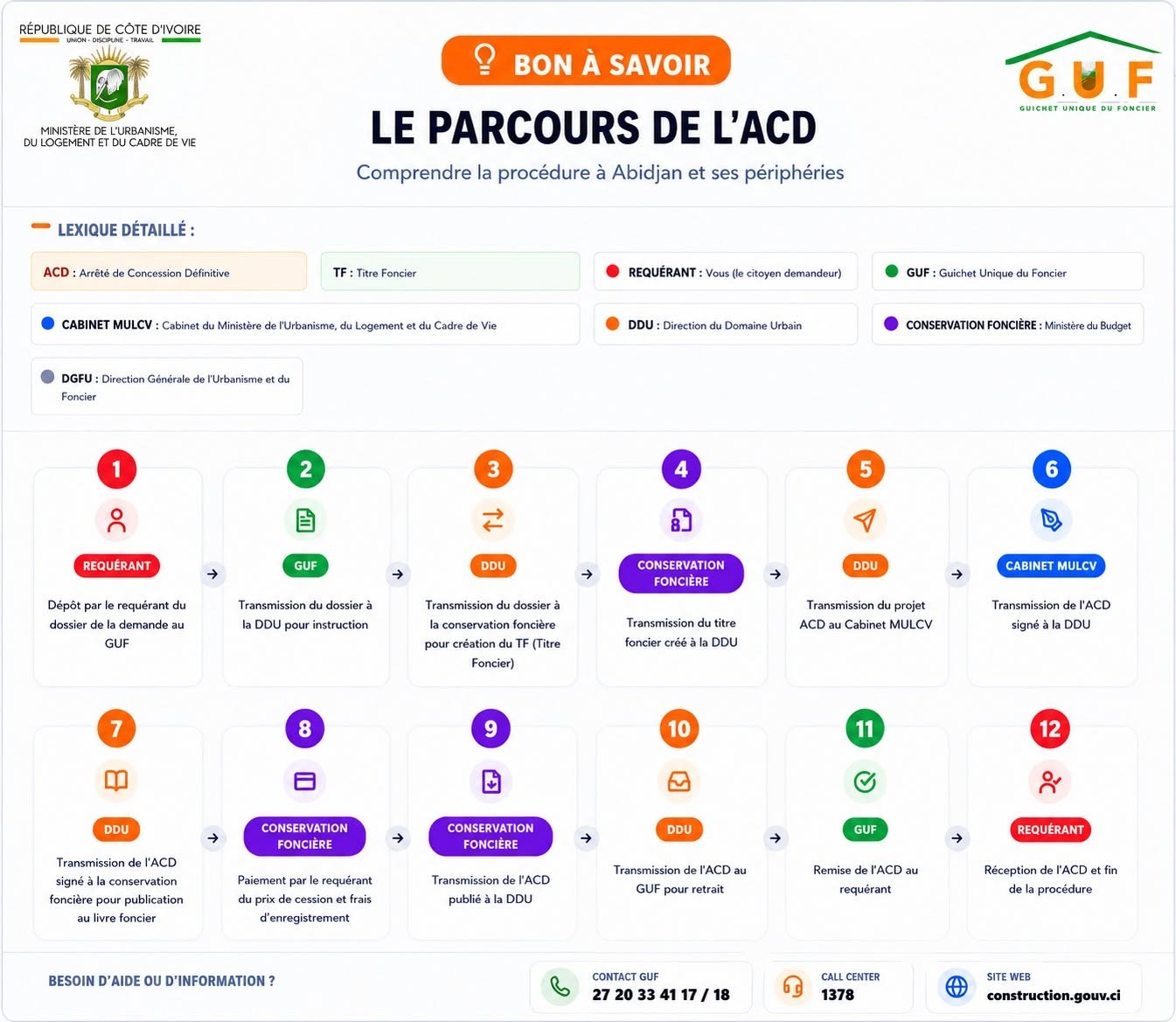
The application is filed at the ministry's Guichet unique du foncier (GUF, one-stop land office), which registers it and gives it a number (Decree No. 2021-785, article 11). As soon as it is filed, the fees, charges and taxes linked to the plot are assessed and notified to the applicant (article 6). The ministry, now called the Ministry of Urban Planning, Housing and Living Environment, sets out a twelve-step process in its "Le parcours de l'ACD" infographic, grouped here into seven:
Applications are handled in the Integrated Urban Land Management System (SIGFU), created by Decree No. 2021-862 of 15 December 2021; Decree No. 2021-785 requires ACD files to be processed in line with it (article 5). These texts set no guaranteed timeframe. Track your file with the GUF or the ministry's call centre (1378, shown on its official website) rather than paying a middleman who promises to speed things up.
| Item | Published amount | Source |
|---|---|---|
| Registration duty on a property sale | 4% (standard rate) | DGI 2025 guide, articles 760 to 764 of the General Tax Code |
| Capital gain on sale by an individual or a partnership not subject to corporate tax | 15% | DGI 2025 guide, article 762 of the General Tax Code |
| Notary fees | not published here: ask for a written quote | none |
| Land registry and CMPF fees | not published here: ask the notary for a breakdown | none |
| Chartered surveyor, boundary marking | not published: written quote | none |
The rates come from the 2025 edition of the "Impôts et taxes en Côte d'Ivoire" guide from the Directorate General of Taxes, which includes the 2025 tax annex. A finance law can change them: ask the notary for a written, itemised breakdown before transferring funds, and pay into the notary's account, never in cash to a middleman.
For a home, Law No. 2019-576 of 26 June 2019 establishing the Construction and Housing Code sets the following rules (articles 408 to 456). It repealed Law No. 2018-575 on residential leases (article 552).
Worked example: for rent of 250,000 FCFA, the landlord can ask for at most 500,000 FCFA in advance and a 500,000 FCFA deposit, so 1,000,000 FCFA before moving in, excluding any agency fee. The move-in statement must list rent, deposit, expenses and fees separately (article 488). These rules do not apply to commercial, administrative, industrial or craft premises (article 410).
The ministry sells a "secure lease contract" for residential use at 5,000 FCFA per copy, sold in pairs (one for the landlord, one for the tenant), through bookshops, post offices and the one-stop land office, according to its official poster.
Using an agency is optional (article 419). An agency or broker must, however, be licensed: regularly carrying out these transactions without a licence is punishable by 15 days to 12 months in prison and a fine of 200,000 to 2,000,000 FCFA, or either penalty (article 546). The ministry publishes the list of licensed estate agents (version of 31 August 2026). Being listed in Imonga's directory of professionals does not replace that check.
Under Ivorian law, buying off-plan is a vente d'immeuble à construire (sale of a building to be constructed). It takes two forms: the vente en l'état futur d'achèvement (VEFA), where the buyer owns the works as they are built and pays as construction progresses, and the vente à terme (forward sale), where ownership passes on completion, recorded by notarial deed (articles 110 to 114 of the Construction and Housing Code).
Before reserving, look up the company's exact name on the list of licensed property developers published by the ministry (version of 31 August 2026). It gives the reference and date of each licence; its legend flags licences whose five-year validity has expired and must be renewed.
The Société ivoirienne de construction et de gestion immobilière (SICOGI) no longer exists under that name. At a Council of Ministers in December 2021, the government turned it into a state company called Agence nationale de l'habitat (ANAH, National Housing Agency), according to an APA agency report published by Abidjan.net on 16 December 2021. That report said the body would no longer build social housing itself but coordinate the programme. The Directorate General of State Holdings now describes ANAH (formerly SICOGI) as a majority publicly owned company, 84.18% held by the State, in charge of property development, land development, delegated project management and property brokerage.
For a former SICOGI development, a subscription or a rent-to-own contract, contact ANAH. Do not pay anything for a social housing "subscription" without checking the scheme with ANAH or the ministry, and only pay into an account in the organisation's name.
Two SICOGI developments are listed on Imonga. For Résidence Concorde in Abobo PK18, a May 2010 Le Patriote article, republished by Abidjan.net, announced 2,678 homes on 50 hectares, prices of 9 to 22 million FCFA and rent-to-own over up to 15 years. Those figures are sixteen years old and say nothing about current prices. Cité ADO in Yopougon-Azito has 2,172 social and economic homes according to its listing.
As of 14 September 2026, Imonga lists 10 property developments in Côte d'Ivoire: 7 in Abidjan, 2 in Bingerville and 1 in Grand-Bassam. Four are delivered, two are selling, two are under construction and two are at the planning stage. None shows a current price: the only known figures, for Résidence Concorde, date from 2010. Listings draw on public information, press and developer websites: check them with the developer before paying anything.
The directory lists 49 professionals in Côte d'Ivoire: 38 developers, 10 agencies and 1 listings platform. Eight carry Imonga's "verified" badge, which is not the ministerial licence: check that on the ministry's lists. The directory's SICOGI entry and its ANAH entry refer to the same body. To prepare a loan, the financing calculator estimates a monthly payment from the price, deposit, rate and term you enter.
Customary rights cannot be sold (new article 272), and the ministry rejects village certificates issued after 30 September 2024. A seller with only a certificate cannot pass ownership to you: insist on an ACD or CMPF in the seller's name.
No approved subdivision, no ACD (article 224). Carrying out an urban development without approval is punishable by two months to two years in prison and a fine of 2,000,000 to 20,000,000 FCFA (new article 282), and surveyors or contractors involved are treated as accomplices. Check the subdivision's status before paying.
Off-plan, nothing is payable before the sale contract is signed, except the capped reservation deposit, or if a bank or insurer guarantees repayment (articles 121 and 130). A developer demanding 30% at reservation without a written guarantee is outside the legal framework.
A receipt or promise signed outside a notary's office does not protect you: the transfer is made by authenticated deed. Pay at signing before the notary and have the transfer published straight away.
For rentals, rent in advance is capped at two months and the deposit at two months. Do not pay "viewing fees" to a middleman whose licence is not on the ministry's list, and get a receipt for every payment.
| Need | Contact |
|---|---|
| ACD application or follow-up, subdivision status | One-stop land office (GUF) of the Ministry of Urban Planning, Housing and Living Environment (call centre 1378) |
| Deed of sale, checking the seller's rights, cost breakdown | A notary (Chambre des notaires de Côte d'Ivoire, presented on the ministry's website) |
| Land register publication, CMPF | Land registry (Conservation de la propriété foncière et des hypothèques) |
| Boundary marking | A chartered surveyor (géomètre expert) |
| Developer or agency licence | Lists published by the ministry |
| Former SICOGI development, social housing | Agence nationale de l'habitat (ANAH) |
| Registration duties, lease registration | Directorate General of Taxes (DGI) |
The arrêté de concession définitive is the act by which the State transfers full ownership of urban land registered in its name. It is governed by Law No. 2020-624 (articles 220 to 225) and Decree No. 2021-785, published in the land register, and only granted on a lot from an approved subdivision. In Abidjan the minister signs it; after each resale, a CMPF proves ownership.
For a home, at most two months' rent in advance and a deposit of at most two months, under articles 415 and 416 of the Construction and Housing Code. No other payment can be a condition for signing the lease. The deposit must be returned within a month of handing back the keys, minus sums owed and justified. Commercial premises are not covered.
Not under that name. The government turned it into the Agence nationale de l'habitat (ANAH) in December 2021. The Directorate General of State Holdings lists it as ANAH (formerly SICOGI), 84.18% owned by the State. For a former development, a subscription or a rent-to-own contract, contact ANAH, and check every payment you are asked to make.
We do not publish prices: Imonga has no listings in Côte d'Ivoire, and we found no recent public statistics, with a stated method, on prices by commune. The latest public rent data we found comes from the 2015 ENV survey. For a current price, compare similar properties in the same commune and have the property valued before buying.
Not safely. Since Law No. 2024-351, customary rights are personal, non-transferable and do not amount to ownership. The ministry announced that village certificates issued after 30 September 2024 would be rejected. Only an ACD or a CMPF in the seller's name allows ownership to be transferred by notarial deed.
According to the DGI's 2025 guide, a property sale carries a 4% registration duty, and a capital gain made by an individual seller is taxed at 15%. Notary fees and land registry fees come on top; we do not publish them because we have not consulted an official scale. Ask the notary for a written breakdown before signing.
Pages and legal texts consulted on 14 September 2026.
Real estate in Dakar: land titles, leases, délibérations, buying costs, renting and land traps
Renting or buying in Dakar: what land titles, leases and délibérations are worth, the costs set by the Tax Code, the two-month deposit cap of the 2023 decree and the land freezes. No invented prices: Imonga has no listings in Senegal.
Real estate in Cotonou and Benin: land titles, the ANDF, buying costs, leases and land traps
Renting or buying in Cotonou and Greater Nokoué: land titles and certificates of ownership since the 2023 switch, costs set by the texts, the three-month deposit cap of Law No. 2022-30 and land traps. No invented prices: Imonga has no listings in Benin.
Real estate in Lomé: renting, buying, asking prices, leases and land titles
Renting or buying in Lomé: what 115 Imonga listings in Greater Lomé show, the three-month caps on deposit and rent guarantee, the land title required by the 2018 Code, fees published by the OTR and the traps to avoid.
Accra real estate: Ghana land law, buying, renting, licensed agents and traps to avoid
Buying or renting in Accra: leasehold and customary land under the Land Act 2020, a 50-year lease cap for foreigners, the Lands Commission official search, the six-month rent advance limit, REAC licences and the Bank of Ghana rule on dollars. No invented prices: Imonga has no listings in Ghana.
Ready to move from reading to searching? Browse verified listings or get a free valuation.
The advice above is worth most when applied to a specific property. 126 listings are online, viewable without an account.